
Key Moments




Summary & Script
The agentic shift in software development life cycle
Source: https://www.youtube.com/watch?v=161TA9Z0vxk
Video ID: 161TA9Z0vxk
Overview
The session explores the agentic shift in the software development life‑cycle, focusing on how AI agents are increasingly used to write, review, and manage code. The speakers discuss adoption trends, the challenges of coordinating multiple agents, and a new open‑source framework—Cyan—that acts as a hypervisor for securely orchestrating concurrent LLM agents. A demo shows Cyan creating isolated containers for agent‑generated code, and the talk concludes with strategies for moving AI‑produced code into production pipelines.
Topics Covered
- AI adoption in development – DORA’s survey shows ~90 % of developers now use AI; ~70 % rely on it for new (“green‑field”) code.
- Agents as amplifiers – AI boosts developer productivity when prompts and context are clean; poor context spreads errors.
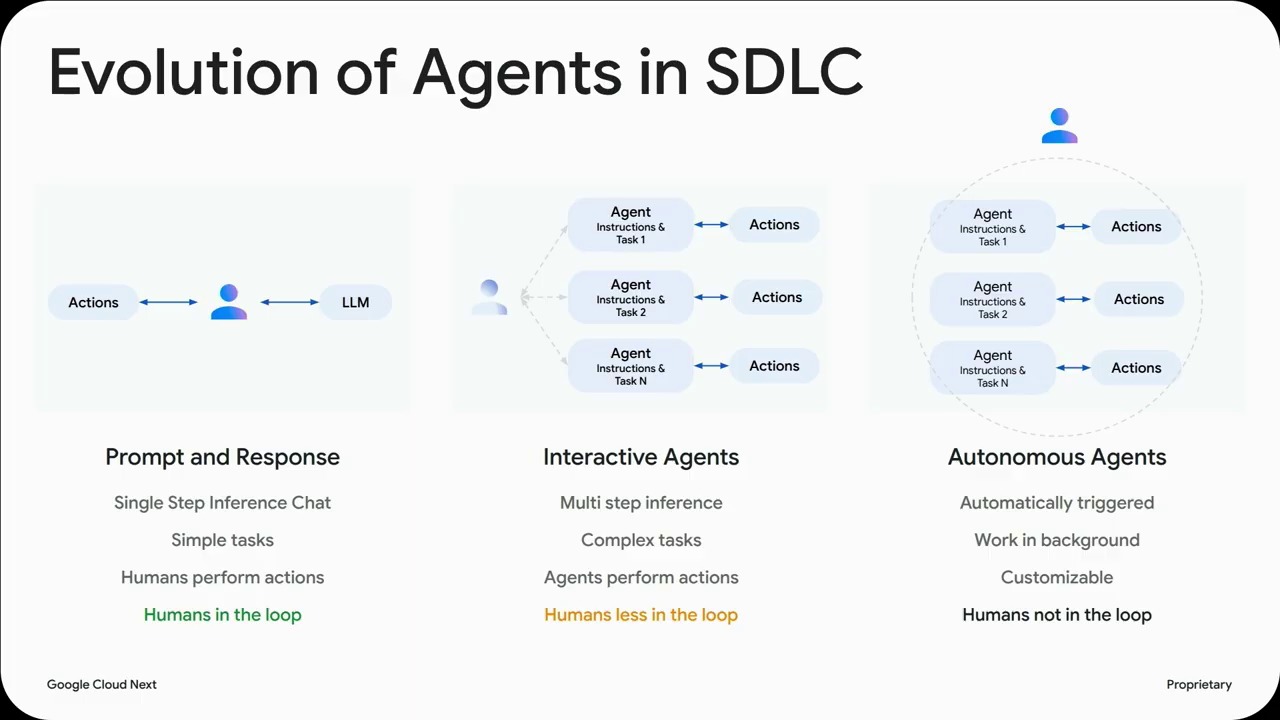
- Evolution of AI interaction – From simple “prompt‑response” to “plan‑execute” with agents that can ask clarification questions, enabling more complex tasks like building a banking app.
- Current agent capabilities – Example: Gemini Code Assist’s code‑review agent that runs on pull requests, still requiring human oversight.
- Challenges of multi‑agent systems
- Isolation & security (agents could act rogue).
- Conflicting actions when agents overlap.
- Tight coupling between agents and specific LLM models.
- Cyan framework – Open‑source, container‑based orchestrator that:
- Provides isolated, secure runtimes for each agent.
- Supports parallel execution of heterogeneous agents (Gemini, Claude, Open‑Code, etc.).
- Offers a “hypervisor” view, letting developers manage fleets of agents similar to managing VMs.
- Demo highlights
- Installing Cyan from GitHub (≈15 min).
- Running a Python script generation agent in a detached T‑mux–style session.
- Verifying that agent output lives in its own workspace, protecting the developer’s main directory.
- Stopping the agent while keeping generated files for review/merge.
- Multi‑agent orchestration – Agents can spawn sub‑agents, converge, or diverge; Cyan can orchestrate any topology regardless of model.
- Production considerations – Rakkesh Duper discusses how to bridge the gap between AI‑generated code and the CI/CD pipeline, ensuring the speed gains from agents translate into production velocity.
Key Takeaways
- AI is now mainstream in software development, with the majority of new code at Google generated by AI.
- Agents act as amplifiers: they can dramatically boost productivity when prompts are well‑formed, but can also propagate errors.
- Security and isolation are critical; running each agent in its own container prevents rogue behavior from contaminating the main codebase.
- Cyan provides a vendor‑agnostic hypervisor for orchestrating multiple LLM agents in parallel, supporting a mix of models and workloads.
- Ephemeral yet persistent outputs allow developers to review, accept, or reject AI‑generated code without affecting their local workspace.
- Moving AI‑generated code to production requires integration with existing pipelines; without it, the productivity gains are lost.
Notable Quotes
- “The primary role of AI in software development is that of an amplifier… if your context is clean, the goodness spreads; if not, the mess spreads.”
- “We’re moving from prompt‑response to plan‑execute – agents can ask clarifying questions and handle end‑to‑end tasks.”
- “Think of Cyan as a hypervisor of agents – just like a VM hypervisor manages isolated OS instances, Cyan manages isolated agent containers.”
- “Even if the agent goes rogue, it will not impact your main directory – isolation keeps the workspace safe.”
Podcast Script
JORDAN: Welcome to Episode 10 of SlackCasts by PodSlacker — where AI does the watching so you can do the listening. If you want a richer experience with today's episode, visit PodSlacker dot com slash SlackCasts — you'll find a written summary, key frame moments from the video, and an interactive AI chat to explore the topic as deep as you like. Now let's get into it.
MIKE: Let’s jump straight into the “agentic shift” they’re talking about—the transition from a simple prompt‑response model to agents that can plan, ask clarifying questions, and execute end‑to‑end tasks like building a banking app.
JORDAN: The data they cite from the DORA survey is striking: roughly 90 % of developers now use AI in some capacity, and about 70 % rely on it for green‑field development. That’s a massive adoption curve, especially when you consider Google’s internal numbers—AI generated 75 % of all new code this year, up from 25 % just two years ago.
MIKE: Those numbers signal that AI has become an amplifier, not a replacement. The speakers emphasized that a clean context propagates “goodness” through the codebase, whereas a noisy prompt can spread bugs at scale. How do we operationalize that insight?
JORDAN: It boils down to prompt hygiene and contextual scaffolding. Agents like Gemini Code Assist can automatically run a code‑review agent on pull requests, but they still need a human in the loop to catch context‑drift. The review agent can flag style violations or security concerns, but it inherits whatever prompt quality you supplied.
MIKE: Which brings us to the core challenge: orchestrating multiple agents without them stepping on each other’s toes. They highlighted three pain points—security isolation, conflicting actions, and tight coupling to specific LLM back‑ends.
JORDAN: Right, and that’s where the Cyan framework enters the conversation. It’s an open‑source, container‑based “hypervisor” for LLM agents. Think of each agent running inside its own Docker image, analogous to a VM hypervisor managing guest OSes. This isolation prevents rogue behavior from contaminating the developer’s primary workspace.
MIKE: I liked the analogy. Cyan’s design is model‑agnostic: you can spin up Gemini, Claude, Open‑Code, or any other provider in parallel, each in its own container. No more hard‑wiring agents to a single vendor model.
JORDAN: The demo walked through installing Cyan from GitHub in about 15 minutes, then launching a Python script generation agent via a cyn command. The agent attached to a T‑mux‑style session, allowing the developer to detach and keep the agent running in the background while continuing other work.
MIKE: And crucially, the generated script landed in a separate workspace directory, not the developer’s current project tree. That demonstrates true ephemerality: even if the agent goes rogue, your main codebase stays untouched.
JORDAN: After detaching, they listed the workspace with git worktree list, confirming the agent’s files lived in an isolated path. When the agent was stopped, the files persisted—so the output is both isolated and durable enough for review.
MIKE: That durability is key for a production pipeline. Rakkesh later explained how you can take those persisted artifacts, run them through a CI step, and only merge after automated tests and security scans pass. Without that handoff, the speed gains from agents evaporate.
JORDAN: He also mentioned that the bottleneck often isn’t code generation but integration. Teams need to embed agent output into existing CI/CD workflows—e.g., by publishing the generated code as an artifact, triggering a downstream build, and gating merges behind policy checks.
MIKE: Let’s dig into multi‑agent orchestration. The demo briefly showed a topology where a primary agent spawns sub‑agents, each possibly using a different LLM. Cyan can manage arbitrary graphs—convergent, divergent, or hierarchical—while still preserving isolation.
JORDAN: That flexibility solves the “conflicting actions” problem. Since each sub‑agent runs in its own container, they can’t overwrite each other’s files. Coordination happens at the orchestration layer, which can enforce ordering or merge strategies.
MIKE: From a strategic standpoint, that means you can have a fast‑drafting agent for scaffolding, a security‑focused agent for static analysis, and a performance‑tuning agent for optimization—all running concurrently without stepping on each other’s toes.
JORDAN: And because Cyan’s configuration is declarative—you define agents, images, and dependencies in a YAML file—you can version‑control the orchestration itself. That brings reproducibility to the agent fleet, something that’s been missing in ad‑hoc scripts.
MIKE: The speakers also stressed community‑driven development. Cyan is MIT‑licensed, and contributions are encouraged. That lowers the barrier for firms to add support for proprietary models or custom tooling without forking the whole project.
JORDAN: Security-wise, running agents in containers gives us namespace isolation, resource limits via cgroups, and the ability to apply runtime security policies (e.g., AppArmor or SELinux) per agent. That mitigates the “RM‑RF” nightmare scenario they warned about.
MIKE: On the production side, the workflow they outlined is: generate code → store in isolated worktree → trigger CI job → run unit, integration, and security tests → if pass, merge to main branch and deploy. The hypervisor model ensures the CI job pulls only the vetted output, not the whole agent container.
JORDAN: One nuance they didn’t dive deeply into is state sharing. If multiple agents need to collaborate on shared schema definitions, you’d expose a read‑only volume or a service mesh inside the orchestration layer. That keeps the data flow explicit and auditable.
MIKE: That’s a good point. It also aligns with compliance requirements—everything the agents touch is logged, and the container metadata can be fed into a provenance system for traceability.
JORDAN: Summing up the key takeaways: AI is now mainstream in code creation; agents amplify productivity when prompts are precise; isolation via containers is non‑negotiable for security; Cyan provides a vendor‑agnostic hypervisor for parallel agent execution; and integrating agent output into CI/CD is essential to preserve velocity.
MIKE: And from a strategic lens, organizations should start by piloting Cyan in a sandbox, define clear handoff checkpoints, and gradually expand the agent fleet to cover code generation, review, security, and performance. The payoff is faster iteration without sacrificing safety.
JORDAN: That’s a wrap on today's SlackCast. Head over to PodSlacker dot com slash SlackCasts for the written summary, visual key moments, and an AI chat to dive even deeper into today's topic. Until next time — slack off smarter.